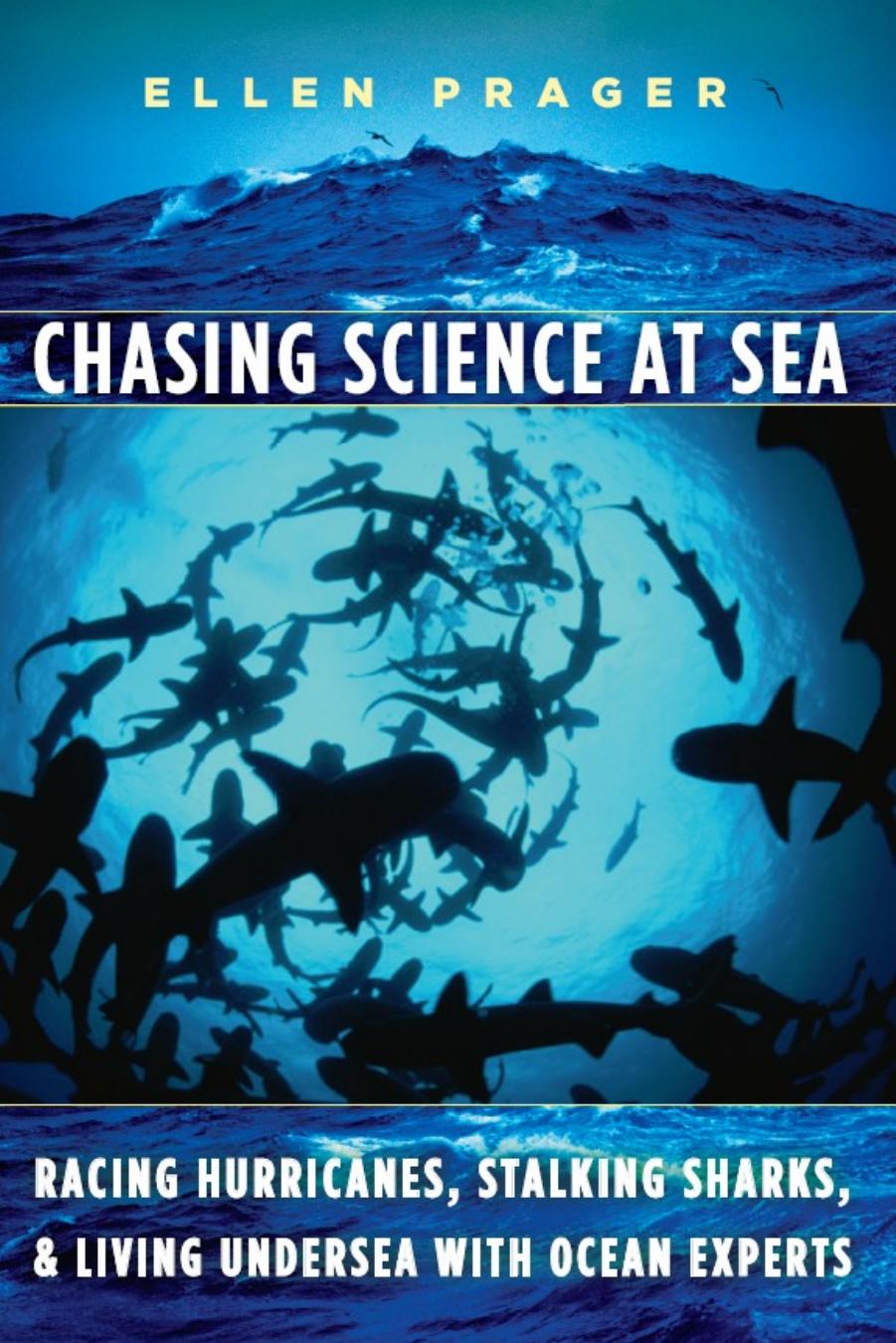
Chasing Science at Sea: Racing Hurricanes, Stalking Sharks, and Living Undersea with Ocean Experts by Ellen Prager
Author:Ellen Prager [Prager, Ellen]
Language: eng
Format: mobi, pdf
Published: 2011-05-03T15:36:11+00:00
5 Overcoming Obstacles
I N P R E PA R I N G F O R F I E L D W O R K AT S E A , scientists must be optimistic, yet learn to adhere to a useful motto ⎯ what can go wrong probably
will. For the ocean is an unforgiving mentor. Ever-changing sea and weather conditions are the norm. Mechanical and electrical failures are likely, and equipment may be lost. If there were a fi eld guide to ocean science, it would say to also consider uncooperative marine life and the constant threat of bad luck or human error.
Furthermore, by its very nature, the ocean makes research diffi cult, hiding what we want to see and to study. Its vast, wet, and deep expanses limit our access and require creative means to tease out the secrets that lay within.
The obstacles that arise in the fi eld may be foreseen or unexpected. Experience in the fi eld teaches us that simplicity is to be valued, and that duct tape and tie wraps are as essential as water, sunblock, or a GPS. Some problems can be solved easily, while others test our will and ingenuity. We learn to adapt both in terms of our own needs and those of our science. Yet by overcoming obstacles in the fi eld, we become stronger, more committed, and versatile, and it can lead to advances in technology or knowledge.
In the end, the challenges fought in the fi eld will either enrich our success or leave us wanting a new career choice.
82
o v e r c o m i n g o b s t a c l e s
83
I asked my colleagues what frustrates them the most about working in the fi eld. You might expect replies about weather delays, mechanical failures, incompetent assistants, or even sharks. Those, however, are considered a part of the adventure and the challenge of working in the sea ⎯ they go with the territory. Researchers fi nd limited and inadequate funding, the burdens of bureaucracy and risk management, and the increasingly exorbitant amount of time that must be spent writing proposals, fi lling out paperwork, and participating in administrative meetings much more frustrating and diffi cult to deal with. And as George Matsumoto of the Monterey Bay Aquarium Research Institute sees it, it’s not only a challenge to fi nd funding, but surprising that more money is not directed toward basic ocean research and exploration.
One big problem is simply that the ocean is diffi cult and costly to study. Our access to the sea is limited both in space and time.
Imagine how much simpler it would be if we could just look into the ocean from the surface to see what lies at the seafl oor or what creatures were swimming within. Marine biologist Sonny Gruber of the Rosenstiel School has been studying sharks for more than thirty years. From his early work on shark anatomy and physiology to his current ten-year effort to better understand the life history of lemon sharks, Sonny has become one of the world’s foremost experts on sharks.
Download
Chasing Science at Sea: Racing Hurricanes, Stalking Sharks, and Living Undersea with Ocean Experts by Ellen Prager.pdf
This site does not store any files on its server. We only index and link to content provided by other sites. Please contact the content providers to delete copyright contents if any and email us, we'll remove relevant links or contents immediately.
The Lonely City by Olivia Laing(4801)
Animal Frequency by Melissa Alvarez(4470)
All Creatures Great and Small by James Herriot(4319)
Walking by Henry David Thoreau(3960)
Exit West by Mohsin Hamid(3826)
Origin Story: A Big History of Everything by David Christian(3692)
COSMOS by Carl Sagan(3623)
How to Read Water: Clues and Patterns from Puddles to the Sea (Natural Navigation) by Tristan Gooley(3469)
Hedgerow by John Wright(3360)
How to Read Nature by Tristan Gooley(3341)
The Inner Life of Animals by Peter Wohlleben(3318)
How to Do Nothing by Jenny Odell(3302)
Project Animal Farm: An Accidental Journey into the Secret World of Farming and the Truth About Our Food by Sonia Faruqi(3221)
Origin Story by David Christian(3201)
Water by Ian Miller(3184)
A Forest Journey by John Perlin(3074)
The Plant Messiah by Carlos Magdalena(2934)
A Wilder Time by William E. Glassley(2862)
Forests: A Very Short Introduction by Jaboury Ghazoul(2842)
